
Editorial Note:
In the summer of 2025, Samadhwani began a Village History and Cultural Documentation Internship Program, asking students to research and document the histories of their own villages. In that first year, around 40 students from schools and colleges across Odisha and from Jamshedpur Women’s University in Jharkhand took part and produced valuable documentation. In 2026, we tried to go further. More than 160 students joined this year’s program. Students from universities in Odisha and beyond, including Jamshedpur Women’s University and Sikkim University, took part in this internship program. Students from all the language departments of Jamshedpur Women’s University came forward together and recorded the history, culture, education, festivals, and food of their own villages.
These students are doing more than documenting villages. They are protecting the culture of Seraikela-Kharsawan, Jamshedpur, and other regions of Jharkhand. We hope the Government of Jharkhand will take note of this effort, and we thank Jamshedpur Women’s University for encouraging its students to take part in this important program. If every university and college ran a campaign like this, Jharkhand’s history would be written by its own young students. This is not only history. It is a record of people’s lived experience. With this in mind, we are publishing Baso Hansda’s story. Please read it and share your thoughts. – Swayamprava Parhi
About Baso Hansda (Student Historian):
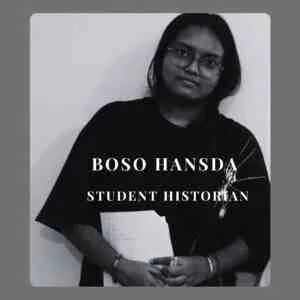
Baso Hansda is an English Honours student at Jamshedpur Women’s University. She comes from Kelabagan village in Musabani Block, East Singhbhum District, Jharkhand, a small Santhal village of about 22 to 23 families. Her father’s job took the family to another state when she was three, so she grew up knowing little of her village. One thing stayed with her: her father always insisted on speaking Santali at home. She joined the program in 2026 to find out how Kelabagan got its name, who settled it first, and where she comes from. Over the following weeks, she recorded seven villagers, among them an elder who is an advocate, housewives, a teacher, and young students, and the account below is the result. It traces the village to about 1939, when families from Odisha came to work in the Musabani copper mines, and to its earlier name, Chota Dera. It covers the Sakrat, Sohrai and Baha Bonga festivals with their foods, leaf plates and songs, the Santhal forms of marriage, and present concerns such as water, schooling, healthcare and the discrimination elders still remember.
She offers no grand plan, only a clear wish: better schools and roads, a hospital within reach, and children who still speak Santali and join the festivals. The work taught her that most of Kelabagan’s history has never been written down. It lives with its elders, and it is lost if nobody records it. It also brought her back to her roots and left her proud of her Santhal identity.
Introduction:
My name is Baso Hansda, and I am an English major pursuing my Bachelor of Arts (Honours) in English at Jamshedpur Women’s University. As part of the Village History and Cultural Documentation Internship Programme under SAMADHWANI, I conducted a research study on my village to document its history, culture, traditions, development, and present-day condition.
I chose my village for this research because my family has lived in another state for many years due to my father’s job. Since I moved away when I was only three years old, I knew very little about my village’s history, traditions, and cultural heritage. Through this study, I wanted to learn how Kelabagan got its name, who its first settlers were, how the village developed over time, and to gain a better understanding of my own roots.

To be very honest, during my childhood, I did not pay much attention to my culture or its history. However, as I grew older, I saw my friends sharing photographs and stories about their festivals, customs, and traditions on social media. This made me curious and inspired me to learn more about my own heritage.
My father always encouraged me to stay connected to my roots. Although I grew up outside my native place and used different languages in my daily life, he made sure that we spoke the Santali language at home. Because of his guidance, I never forgot my mother tongue, and it continues to be an important part of my identity.
Kelabagan is a village inhabited mainly by members of the Santhal community. Being a member of this community, I have always felt proud of my cultural identity. This research gave me a valuable opportunity to reconnect with my roots, understand my village’s past, and appreciate the traditions that have been preserved for generations. I hope this report will help preserve the history and culture of Kelabagan for future generations and encourage others to value their own heritage.




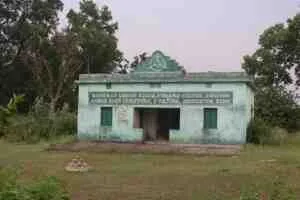
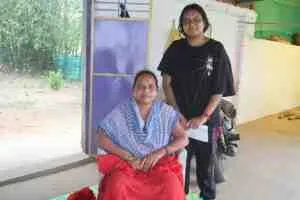
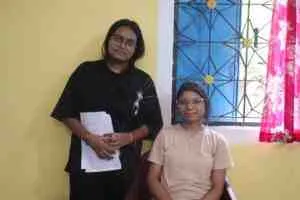
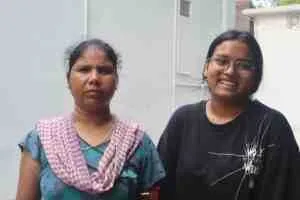

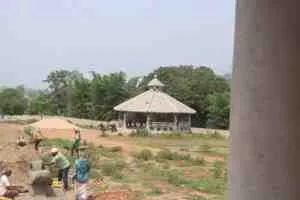

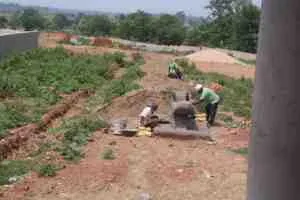


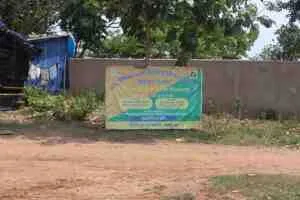
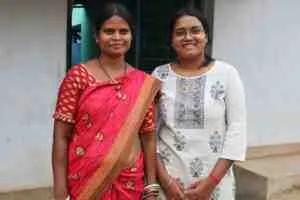


For this research, I interviewed elders, women, youth, and other Santali residents of Kelabagan to collect information about the village’s history, education, agriculture, festivals, traditions, social life, and present-day challenges. This study is a small effort to preserve the memories, knowledge, and cultural heritage of the Santali community so that future generations can understand, value, and stay connected to their roots.
General Description and Profile of Kelabagan village
Kelabagan is a residential village located in Musabani Block of East Singhbhum district, Jharkhand. It is situated at approximately 22.5035° N latitude and 86.4541° E longitude. The village lies in a historically important mining region that is well known for its early copper mining activities. Its growth and development are closely connected with the British-era mining industry.
Because of mining activities, people from different places, especially from Odisha, settled in the area over the years, making Kelabagan a culturally diverse village. Unlike many villages, Kelabagan does not have a river or waterfall. However, a pond located at the entrance of the village, but it isn’t for the village water supply; it is used to raise fish. The surrounding area reflects a mixture of natural landscapes and semi-urban development due to its closeness to mining and nearby towns.
My village is a small and peaceful village. Around 22–23 families live in the village, and all of them belong to the Santhal community. The villagers share a close bond and live together with unity and mutual respect.
The village does not have a farming background. However, many families raise goats, chickens, and cows for household use and as an additional source of income; they also grow vegetables and fruits in their gardens for their household.
Each house has its own water supply from the government, but because sometimes water doesn’t come, they have to go to a nearby water pump to bring drinking water; however, now not all of the residents go to bring drinking water from the water pump, as most of the families have their own water pumps in their houses.
There are no rivers or forests near the village. The climate is seasonal, with summer, monsoon, autumn, winter, and spring experienced throughout the year.
There is no school in the village. Children go to a nearby village to study, where education is available up to the high school level. Students who wish to continue higher education have to travel to nearby towns or cities.
There is no hospital in the village, but medical shops are available nearby for basic medicines. For serious illnesses or emergencies, villagers visit hospitals in nearby towns.
Now the roads in the village are in good condition, making travel convenient. Almost every family owns a vehicle, such as a motorcycle, scooter, bicycle, or car, which helps them travel for work, education, shopping, and healthcare.
The elders recalled that, in the past, the khulhis (village lanes) were not developed as they are today. Instead of proper pathways, there were only simple earthen tracks connecting one household to another. During the monsoon season, heavy rainfall turned these roads into thick mud, making it extremely difficult for people to walk from one place to another. Daily activities such as going to work, visiting neighbours, or carrying essential goods became challenging because of the poor condition of the roads.
Over the years, the development of proper khulhis and improved pathways has greatly enhanced transportation within the settlement. The elders consider this improvement to be one of the significant changes that have made everyday life easier for the residents.
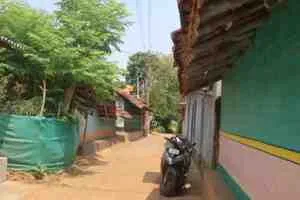
*The road shown in the picture is called a khulhi.
Present Condition of Kelabagan Village
At present, Kelabagan is a semi-urban to rural village with a simple and close-knit community. The village has groups of houses connected by small internal roads, creating a peaceful and village-like environment. Mining activities have reduced over time, so many people now depend on nearby towns for jobs, higher education, shopping, and other essential services.

Basic public and administrative services are available through the Common Service Centre (CSC), which serves Kelabagan as well as nearby villages like Badia and Kendadih. The village is well connected by road to larger towns in the Ghatshila subdivision, making it easier for people to access transport, markets, hospitals, and other district-level facilities. Although Kelabagan has a calm rural setting, it is socially and economically connected with the rest of East Singhbhum district.
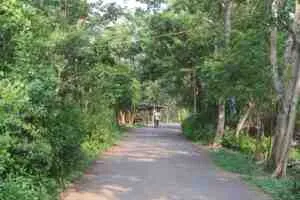
Kelabagan is mainly inhabited by the Santhali community. It is well connected by road to nearby towns such as Musabani and Ghatshila. The people speak Santhali as their mother tongue.
People in the village are not involved in agriculture. Even in the past, the residents of Kelabagan didn’t really have any farming background, as the residents of that time migrated from different places like Odisha for jobs in Musabani mines, and now also most residents depend on mining-related work, government jobs, private jobs, and daily wage labour for their livelihood.
HISTORY OF KELABAGAN
Origin and Early Settlement of Kelabagan
The history of Kelabagan has been passed down through the stories of the village elders. According to them, the village was established around 1939 during the British period when the Musabani Copper Mines were expanding.
During this period, many people migrated from different parts of Odisha in search of employment opportunities in the mines. Gradually, these migrant families settled in the area and formed a small community.
Before the village received the name Kelabagan, it was known as Chota Dera. The word Dera refers to a temporary camp or settlement where people lived. According to local elders, one of the early settlers was a man named Chota Haram, and the settlement came to be known as Chota Dera because of him.
Origin of the Name Kelabagan
The present name Kelabagan has an interesting history. Earlier, the area had many banana trees. In the Santhali language, banana is called Kaira, so the place was first known as Kairabagan. Later, Hindi-speaking people found the pronunciation difficult and gradually started using the name Kelabagan. Over time, this name became commonly accepted and became the official identity of the village.
Growth and Development of the Village
In the early years, only a few families lived in the village. Most of them had come to work in the Musabani mines rather than for farming. Whenever jobs were available in the mines, a metal bell was rung to inform people. Many residents first worked as domestic helpers in nearby houses until they got jobs in the mines. As more employment became available, more families settled here, and the village slowly grew. As mining activities expanded and more job opportunities became available, more families settled in the area. Gradually, the small settlement developed into a larger village.
Roads and Transportation in Earlier Times
The elders recalled that, in the past, the khulhis (village lanes) were not developed as they are today. Instead of proper pathways, there were only simple earthen tracks connecting one household to another. During the monsoon season, heavy rainfall turned these roads into thick mud, making it extremely difficult for people to walk from one place to another. Daily activities such as going to work, visiting neighbours, or carrying essential goods became challenging because of the poor condition of the roads.
Over the years, the development of proper khulhis and improved pathways has greatly enhanced transportation within the settlement. The elders consider this improvement to be one of the significant changes that has made everyday life easier for the residents.
Culture, Traditions and Social Life
Although the main reason for settlement was employment, the people of Kelabagan continued to preserve their Santhal identity, traditions, language, and customs.
Kelabagan is inhabited mainly by the Santhal community. Festivals such as Baha Bonga, Sohrai, Sakrat, and Karam are celebrated with great enthusiasm. During the Baha festival, people worship Baha Bonga, the deity of flowers and nature. They also perform traditional rituals to honour their ancestors and pray for the well-being of their families. Traditional foods and offerings, such as Handia (rice beer), chicken, and Pitha, are prepared according to Santhal customs. However, every festival’s offerings are different.
According to the elders, the people lived peacefully and helped one another. Even though farming was not their main occupation, they continued to preserve their Santhal traditions, language, and customs.
Today, Kelabagan has developed into a well-established village. Many people work in government services, private jobs, and mining-related occupations. Even with these changes in their lifestyle
Marriage Traditions and Oral History
Marriage has always held great cultural and social significance in the Santhal community of Kelabagan. According to the elders, the traditional Santhal marriage ceremonies were well known for their customs, discipline, and community participation. They recalled that during the British period, British officials were impressed by the unique marriage traditions of the Santhal people. The elders further stated that these marriage customs were even recorded in official British records. Although this account has been passed down through oral tradition, it continues to be an important part of the community’s collective memory.
The elders also explained that the Santhal community recognizes seven different types of marriages, each performed under different social circumstances and according to traditional customs. These forms of marriage reflect the flexibility and richness of Santhal culture while emphasizing family values, mutual respect, and community approval.
Stories of the past
lifestyle, the people continue to preserve their culture and traditions for future generations. Apart from historical facts, the elders also shared many stories and beliefs that have been passed down from one generation to another. Although these stories cannot be historically proven, they remain an important part of the cultural identity and heritage of Kelabagan. The elders also remembered that people in earlier times lived with unity and shared everything with one another. If someone brought sweets from outside, they shared them with the whole community instead of keeping them only for their family. This showed the strong bond and togetherness among the villagers. During an interview, Mr. Rajmal Tudu, one of the respected elders of Kelabagan, shared several traditional beliefs and memories. According to Mr. Tudu, there was once a famous elder named Ramechandra Mardi. Before Mr. Tudu was born, a large banyan tree stood in the centre of the village. In the Santhali language, it was called Aakhra. People believed that supernatural spirits (Bhoot Bonga) visited the tree at night and drove iron nails into it. They also believed that during that time many married couples could not have children. According to local tradition, after the banyan tree was cut down, children began to be born again. Although this is based on traditional belief and not historical evidence, it is still remembered as an important part of the village’s cultural heritage. Mr. Tudu also shared memories of the difficult living conditions in the past. During his childhood, there were very few places for bathing. The main pond at the entrance of the village was about nine feet deep, and its water remained cold throughout the year. Because of this, many children were afraid to bathe there. Some children instead went to the nearby village of Badia for bathing. These memories help us understand the daily life, beliefs, and experiences of the people in earlier times. They also show how oral traditions have helped preserve the history and identity of the Santhal community of Kelabagan.
Agriculture & Food:
My village does not have a farming background. Most of the families living in the village originally migrated from Odisha many years ago. They settled here mainly to work in the Musabani mines. Because of this, agriculture has never been the main occupation of the villagers. Only a few families grow vegetables in small kitchen gardens around their houses. These vegetables are mainly used for household consumption and are not grown for commercial purposes. Animal rearing, such as keeping goats, chickens, and cows, is more common than farming in the village. However, the families who grow vegetables only grow vegetables like chilies, tomatoes, mogra, etc.; villagers mostly buy all kinds of groceries, food supplies, and vegetables from the market.
Food Habits in the Past
In the past, the food habits of the villagers were simple. Rice was the main staple food and was usually eaten with seasonal vegetables and chicken on special occasions or when available. The meals were homemade and depended on locally available ingredients.
Present Food Habits
Today, the food habits of the villagers have changed. People prepare a greater variety of dishes than before. Although different types of food are now cooked, rice remains the staple food of almost every family.
Many families usually eat pani bhaat or maar bhaat (soaked rice; however, in Santhali we call it Baske daka) with vegetables in the afternoon, especially during the summer season. At night, most families eat rice with vegetables, dal, or meat, depending on what is available. Compared to the past, people now have access to more food choices and enjoy preparing different kinds of meals.
Comparison Between the Past and Present
The biggest change in the village is the variety of food. In the past, meals were simple and mostly consisted of rice, vegetables, and occasionally chicken. Today, people cook many different types of dishes while continuing to eat rice as their staple food. Although food habits have changed over time, traditional foods such as pani bhaat (baske daka in Santhali) are still commonly eaten by many families.
Santhal Marriage Traditions
Marriage is an important part of Santhal culture and is considered a bond not only between two individuals but also between their families and communities. In the Santhal community, there are traditionally seven different types of marriage, which were followed according to different situations and customs. However, some of these forms are no longer practiced and have been stopped because of social, cultural, or other reasons.
Santhal marriage ceremonies include different traditional customs and rituals, and the participation of family members and the community is very important. Elders play an important role in guiding the families and maintaining the customs. Marriage is also connected with the community’s traditions, music, food, and celebrations.
According to the elders of Kelabagan, Santhal marriage traditions have been followed by the community for generations. They also shared that during the British period, the Santhal marriage system attracted the attention of British officials. According to the oral tradition shared by the elders, the British officials were pleased with the Santhal wedding ceremony and recorded it in their books. This information is part of the oral history of the community.
The seven forms of marriage show that Santhal society had different ways of recognising a marriage depending on the circumstances. Some forms that were accepted in the past are not commonly practiced today. Therefore, documenting these traditions is important because some of them are slowly disappearing from everyday community life.
Culture
In my village, we mainly celebrate Sohrai, Sakrat, and Baha Bonga. These festivals are an important part of our Santhal culture. During these occasions, everyone comes together, prepares traditional food, follows our customs, and celebrates with each other. I feel that celebrating these festivals is one of the ways through which our younger generation can stay connected to our culture and traditions.
Sakrat (makar)
Sakrat is one of the important festivals celebrated in Kelabagan. The preparation starts from the first day, when people make leaf plates and leaf bowls for the next day’s rituals. At night, different types of Pithas are prepared, such as Gur Pitha(jaggery), Chicken leeto, Chicken Pitha (in santhali chil pitha), Sukri Pitha(pork), and Chini Pitha(sugar). On the first day of Sakrat, before sunrise, we have a bonfire as a welcome to Sakrat; it is called Bhudi Kumba. The night before Sakrat, every house prepares food like chicken or vegetables, and we put our plates outside, as I heard my mother say that we do this because an entity called Sakrat Budhi comes by and counts the plates.
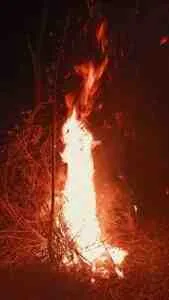
*The picture below of a bonfire is called Bhudi Kumba. The Bhudi Kumba is made of dried plants that the children of the village collect a few days before the start of Sakrat so that they can burn it on the morning of the first day. As the fire is burning, the children would scream, ‘BHUDHI KUMBA’.
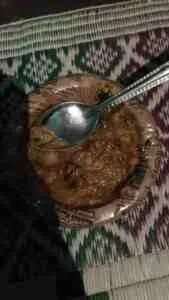
*The dish in the picture is called Leeto, which is made of rice flour which are not grinded till they are completely powdered, and it has a few chunks of adwa rice; excluding rice flour, it has another ingredient, which is chicken.
*This dish in the picture below is called Gur pitha. The ingredients are rice flour, nuts, and jaggery.

*This dish in the picture below is called chini pitha. The ingredients are white sugar powder, nuts, and rice flour.
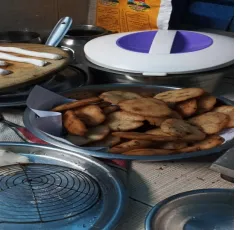
*This dish in the picture below is called Jil Pitha (chicken pitha). The ingredients are rice flour and chicken.

*The picture below is of how jil pitha is cooked by covering it in Sarjoom leaves and are cooked on a pan til the leaves are all brown and black, like in the picture.

Before eating the pithas, they are first offered to the ancestors. According to our oral tradition, our ancestors are like guardians who never truly disappear. They are believed to wait for the festivals so that they can celebrate with us. By offering the first food to them, we show our respect and believe that they take away evil and negativity, allowing us to celebrate the festival peacefully and happily.
Another important part of Sakrat is Handi (rice wine or rice beer), the homemade rice wine traditionally prepared by the Santhal community. It is prepared before the festival so that it can be offered to the ancestors on the day of Bonga. Before the Bonga ceremony, water is added to the Handi. According to our tradition, this is done so that it does not become too strong and also to increase its quantity because relatives and guests visit the house during the festival.
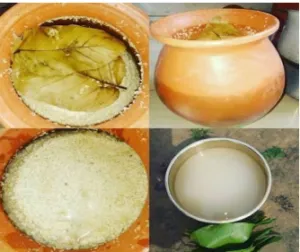
The picture shown below is called Handi (rice wine or rice beer). The ingredients to make Handi are cooked rice and Ranu (a small ball-like thing which are roasted a bit, then ground into pieces and then mixed well with the cooked rice, which is out to cool down). In summer, the handi gets ready quickly, in 2-3 days because of the heat. However, in winter it takes at least 4-5 days to get ready because of the cool weather. We even place a few sarjoom leaves on top of the handi.
*The picture shown below is called Ranu. These are the main ingredients to make handi.

On the day of Bonga, also the second day of the Sakrat, the male member of the household offers Handi to the ancestors in a freshly prepared leaf bowl, and in the bowl we pour handi and offer our ancestors the handi. After making the offering, he also drinks it as part of the tradition. These practices make Sakrat more than just a festival; it is also a time when we remember our ancestors, respect them, and celebrate together as a family and community.
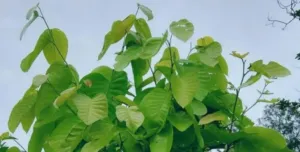
*The picture shown below is of sarjom leaves.
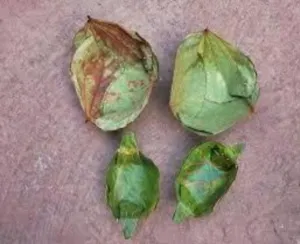
*The picture shown below is of a sarjoom leaves plate (in santhali plate are called thari). This is made by hand with sarjoom leaves.

*The picture shown below is of a sarjoom leaves bowl (in Santhali, a bowl is called fhuru).
On the third and final day of Sakrat, the whole village comes together to celebrate. Different sports and games are organised for the villagers, and people take part in them, dance, and enjoy the day together. Before the festival begins, the men of the village collect chanda from the households. This money is used to arrange prizes for the sports and make the celebration more enjoyable for everyone.
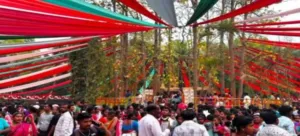
*The picture below is from the third day of Sakrat, when my village had organised a sports event. In the picture, the women and girls had made a line for a game.
After one or two days, another tradition called Gaanri Aasen takes place. In this tradition, the men dress up as women and go from house to house while dancing. They collect things such as rice, oil, vegetables, and spices from the households. The following day, the people who participated in Gaanri Aasen prepare khichdi in a traditional Santhali cooking vessel called Soore. The khichdi is then distributed throughout the village, with each household receiving a portion.
In this way, Sakrat comes to an end with everyone coming together, sharing food, enjoying themselves, and maintaining the spirit of unity within the community.
Sorhai (Diwali)
*The picture is of Khulhi from the time of Sorhai.

Sohrai is one of the most important festivals celebrated by the Santhal community. It is a three-day festival dedicated to cattle, nature, and thanksgiving after the harvest. Sorhai is basically celebrated for the animals who had work hard for the harvest and our day to life. In Kelabagan, some traditions are still followed, while others are mainly practiced in more traditional Santhal villages.
First Day – Good Bonga
The first day of Sohrai is known as Good Bonga. The rituals are performed with the guidance of the Nayeke, who is the traditional priest of the community. Joom Majhi has a separate role in the village and is also involved in the arrangements for the ceremony. The Joom Majhi collects items such as rice, leaf plates, Sahan (firewood), and Siim Busa from the villagers. The villagers then go with the Nayeke to perform Good Bonga.
On the same morning, Guriij is performed inside the village, including the bhitar, raacha, pinda, and khulhi. In the evening, lamps are lit. The people who have gone for Good Bonga bring the animals to the place where the ceremony was performed. Cows, goats, buffaloes, and other animals are taken there, while an egg is placed on the ground. The villagers observe which cow touches or breaks the egg, and the owner of that cow becomes part of a traditional and playful ritual called Ghoora. During this ritual, the people return towards the village together with the Nayeke while singing and speaking loudly in a playful manner.
After returning home, lamps are lit in different parts of the house. In the past, when proper lamps were not available, oil was placed in a small leaf bowl, and a clean white cotton cloth was used as a wick. A bowl was also made from the leaves of the Sarjom tree. In earlier times, cows were an important part of almost every household, so people would go from house to house singing and performing Chumara for the cows. Both boys and girls took part in these celebrations, and the whole night was spent together singing and celebrating.
During the night, vegetables, rice, potatoes, and other food items were collected from different households. Sometimes people would jokingly take vegetables from gardens, although the owners would also give them when asked. The collected food was used to prepare Khichdi in the traditional Santhali Soore, which was prepared twice during the night and shared among the boys who participated in the celebration.
Since Kelabagan has become more of an urban-rural settlement, Sohrai is not celebrated here today as elaborately as it is in some more traditional Santhal villages. However, some important customs are still followed. Girls wear traditional sarees and carry Haatha containing Adwa rice and Dhubi grass, along with a lota of water. They visit the houses where cows are kept while singing and perform Chumara for the cows. In this way, even though the celebration has changed over time, the people of Kelabagan continue to preserve important parts of the Sohrai tradition.
Second Day – Dhaka
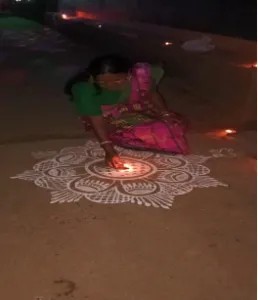
The second day of Sohrai is known as Dhaka. On this day, every household prepares food for the family and spends most of the day cooking. The entrance of the house and the gates of the different rooms are decorated with flowers made from Adwa rice. This decoration is called Oolpina. In more traditional Santhal villages, Oolpina is made in a square shape with flowers on the sides and a cross-like design in the middle. Grass is then spread lightly over the decoration, and one or two diyas are placed on top.
* The picture shown below is the present-day design of oolpina.
* The picture shown below is how a proper Santhal village makes oolpina.
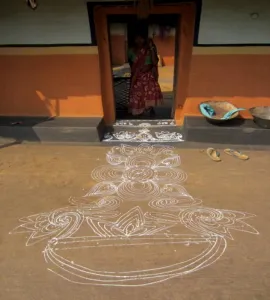
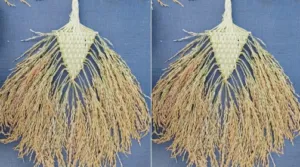
When the cows are brought back home, they are made to walk over the Oolpina while smelling the diya. The household also prepares a Dhumbu from flour and places it onto the Haatha. The cows are then given Chumara three times. This ritual is performed at night and again the next morning. After the morning Chumara, the cows are taken to the fields. These rituals show the importance of cattle in Sohrai and the respect given to them by the Santhal community. The villagers hang the decoration, which is made of dhaan.
*The picture given below is a wall decoration which is made of paddy. It is also known as a symbol of prosperity.
Third Day
On the third day, the entire family comes together to perform Chumara for the cattle. Married women, elderly women, and young girls participate in separate groups. The elderly women sing the traditional Sohrai songs because they know the songs better than the younger generations. This day is a time for families to gather and continue the traditions passed down by their elders.
On the following day, known as Jajale, the cattle that were ritually tied are released. From the morning onwards, villagers go from house to house dancing and collecting rice, potatoes, pulses, oil, and other food items. In the evening, Khichdi (soore in Santhali) is prepared and distributed to every household in the village. This community meal marks the end of the Sohrai celebration and reflects the unity and cooperation among the people of Kelabagan.
Baha Bonga(holi)
Baha Bonga is a three-day festival celebrated by the Santhal community. Unlike Good Bonga during Sohrai, the Bonga ritual of Baha Bonga takes place in the Jaher. The three-day celebration includes traditional rituals and community participation.
Baha Bonga is one of the major festivals celebrated by the Santhal community. It is a three-day festival, and the main Bonga ritual takes place in the Jaher, the sacred grove of the village. During this festival, the community worships nature and prays for the new agricultural season. It is considered the beginning of a new cycle of life, marked by the appearance of new leaves and flowers.
Preparations Before Baha Bonga
The preparations for Baha Bonga begin one day before the main festival. The Jaher and the small sacred structure inside it are cleaned. According to Mrs. Karuna Tudu, in earlier times this work was done by unmarried girls, but nowadays it is usually done by unmarried boys.
The unmarried boys go to the Buru on an empty stomach and bring Sarjom branches. They clean the Jaher using bamboo brooms and ordinary brooms. They also prepare traditional decorations from paddy in the shapes of peacocks, elephants, and other designs, which are then hung inside the Jaher.
In the evening, the villagers gather at the house of the Nayeke, where Ruum Bonga is performed. During this ritual, the Nayeke symbolically informs the Bonga that the main worship will take place the next day and asks what materials will be required for the ceremony. The villagers then arrange all the necessary items.
The Nayeke, the Sagun Supari Babu, and the people responsible for carrying the ritual materials stay overnight at the Nayeke’s house. According to Mrs. Karuna Tudu, they sleep separately on clean cloths as part of the traditional ritual observance.
First Day
Early in the morning, everyone bathes before the rituals begin. The Nayeke’s child performs Bhitar Guriij, and together with the Sagun Supari Babu, helps prepare the Nayeke for the ceremony. A ritual called Ruum is performed in the courtyard. Women gather, singing and dancing, and accompany the Nayeke for part of the procession. The men then continue to the Jaher, where the main Baha Bonga ritual is performed.
Traditional offerings are made during the ceremony, including a white goat, a red sandi, a black kalot, and another sandi. According to the community’s custom, only the Nayeke and a few selected people are allowed to eat the head of the sacrificial goat.
In the afternoon, the women visit the Jaher to receive blessings. They then bring the Nayeke back to the village while singing and dancing. The celebrations continue throughout the night with traditional dances. Baha dance is performed until around 10 or 11 p.m., after which the Laangde dance begins.
Second Day
On the second day, between six and seven o’clock in the morning, the Sagun Supari group brings back the water that had been kept overnight. This water is observed as a Sagun (an auspicious sign). If the water remains full, it is believed to be a good sign for the coming year, while a reduced amount of water is considered an unfavourable sign. After observing the Sagun, the participants drink Handi, pour water on one another, sing traditional songs, and then proceed towards the Buru.
At the Buru, they bring back whatever animals they found and take them to the Nayeke’s house to show the animals to nayeke. Then they take A pot of Handi from Nayeke house. The animals are then prepared for the community feast, and the celebrations continue with singing and dancing throughout the night.
Third Day
The third day marks the conclusion of Baha Bonga. The festival celebrates the beginning of a new year in nature, with the growth of new leaves and new flowers. During the festival, offerings are made to three different flowers, including Matkom, Sarjom, and another traditional flower identified by the community. These flowers are worshipped as part of the Baha Bonga rituals.
According to the tradition shared by the elders, if Baha Bonga is not performed, the Nayeke is not allowed to eat any of the new harvest. Only after the festival has been completed and the offerings have been made can the new produce be consumed. This belief highlights the importance of Baha Bonga in expressing gratitude to nature and seeking blessings for a successful agricultural season.
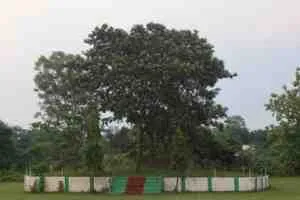
*The picture below is of the Jaher.
*The picture below is also of a Jaher, which is near my village, and during the Baha Bonga time the Nayeke came and cleaned the Jaher before the bonga.
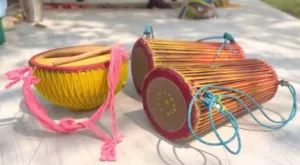
The picture below is of a Santhal community musical instrument called tumdak tamak. These are traditional instruments.
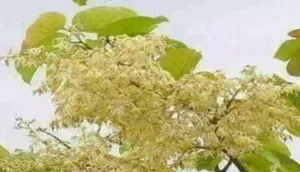
The picture below is of sarjoom baha, which we receive jaher and we put it in hair male put it near their ears.
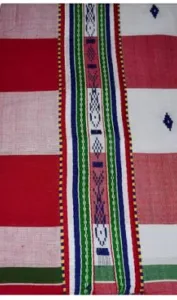
The picture below is of our traditional saree called jhal saree. There are different types of colours too.

The picture below is a Santhal man’s traditional dhoti called kacha.
Village Problems & Public Life:
Problems Faced by the Villagers in the Past
According to the villagers, Kelabagan faced several basic problems before the development of modern facilities. At that time, the village was completely rural and did not have electricity, proper roads, or a regular water supply. These difficulties affected the daily lives of the villagers, particularly their access to drinking water, transportation, education, and other essential activities.
Water Supply and Drinking Water
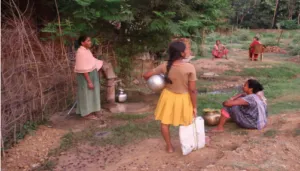
One of the major problems faced by the villagers in the past was the lack of a proper water supply. According to the women of the village, there was no regular supply of drinking water to the houses. Whenever drinking water was needed, people had to walk a considerable distance to collect it from water pumps located away from their homes. This made collecting water a difficult and time-consuming part of everyday life.
The village also had a large pond, which was used for bathing. According to an elder, the water of the pond remained extremely cold, making it difficult for many people, especially children, to bathe there. As a result, some villagers had to go to the pond in the neighbouring village of Badia for bathing.
Over time, the water situation improved. The government provided tap-water connections to many households. However, the supply is not always regular, and sometimes water does not come through the taps. Because of this, some villagers still have to travel a short distance to collect drinking water. Many families have also installed water pumps in their homes, which has helped reduce the problem.
Condition of Roads
Roads were another major problem in the past. Earlier, the roads inside the village were mostly unpaved and made of mud. During the rainy season, water from nearby channels would flow through some of the village paths. This made the roads muddy and slippery and created difficulties for people travelling through the village.
The poor condition of the roads particularly affected movement during the monsoon season. Travelling to nearby villages, markets, schools, or other places became difficult.
With the development of the village, proper roads were gradually constructed. Today, the road conditions are much better, and transportation has become more convenient for the villagers.
Lack of Electricity
In the past, Kelabagan also had no electricity. The absence of electricity affected household activities and made studying at night more difficult.
According to the villagers, when electricity was first introduced, some people were afraid because they were unfamiliar with it and worried about getting hurt or burned. Gradually, people became familiar with electricity, and connections were provided to more households.
Today, electricity has become an important part of public and household life in Kelabagan. It has made daily activities easier and has provided better conditions for children to study at home.
Changes in Public Life
The development of basic facilities has brought considerable changes to public life in Kelabagan. Better roads have improved transportation, electricity has made household and educational activities easier, and water connections have reduced the difficulties involved in collecting drinking water.
At the same time, some problems still remain. The irregular water supply is one of the main concerns for some households. However, the availability of household water pumps has helped many families manage this problem.
The changes in Kelabagan show how the development of basic infrastructure has gradually improved the everyday lives of the villagers. Although the village still faces certain challenges, the people have adapted to these changes while continuing to maintain their close community relationships and traditional way of life.
Migration and Livelihood
The history of Kelabagan is closely connected with the Musabani Copper Mines. According to the village elders, many families migrated from different parts of Odisha to Kelabagan during the British period in search of employment in the mines. Since the village did not have a strong agricultural background, mining became the primary source of livelihood for many families. Even today, many residents depend on mining-related work, government jobs, private employment, and daily wage labour.
Educational Facilities
Education is one of the major challenges faced by the villagers. There is no school within Kelabagan. Children have to travel to a nearby village for their primary and secondary education, where schooling is available only up to the high school level.
Students who wish to pursue higher secondary education, college, or university studies must travel to nearby towns and cities. This often requires additional time, money, and transportation, making higher education more challenging for some families.
Healthcare Facilities
Healthcare facilities are limited in the village. There is no hospital in Kelabagan. For minor illnesses, villagers depend on nearby medical shops or local healthcare providers. However, in cases of serious illness or medical emergencies, patients have to travel a considerable distance to hospitals in nearby towns. This can be difficult, especially during emergencies when immediate medical treatment is required.
Natural Environment
Unlike many villages in Jharkhand, Kelabagan does not have nearby forests, hills, or rivers. The village has a peaceful environment with open residential areas and a pond at its entrance, but the absence of forests and hills makes its geographical landscape different from many other villages in the region.
Social Discrimination and Experiences of the Villagers
According to one of the elders of Kelabagan, the Santhal community faced discrimination and social exclusion in the past. He recalled that when villagers travelled by bus, they were sometimes asked to give up their seats simply because they belonged to an Adivasi community. Such experiences made travelling difficult and created a feeling of inequality and exclusion among the people.
The elder also recalled that the community faced other forms of social discrimination and untouchability in earlier times. These experiences were not limited to one particular incident but were part of the difficulties faced by some members of the community in their everyday lives.
Over time, social conditions have changed considerably. Education, greater social interaction, improved awareness, and changes in society have helped reduce many forms of discrimination. However, according to the villagers, discrimination has not completely disappeared. Even today, there are some places and situations where people may still experience discriminatory behaviour because of their Adivasi identity.
These experiences are an important part of the social history of Kelabagan. They show that the development of the village is not limited to improvements in roads, electricity, and water supply. Social equality, dignity, and acceptance are also important aspects of development and public life. The experiences shared by the elders help younger generations understand the difficulties faced by earlier generations and the importance of building a more equal and inclusive society.
My Vision for the Future of Kelabagan
I want to see my village continue to grow and develop while preserving its culture and traditions. I hope that the quality of education improves so that children and young people can receive better learning opportunities without having to travel far. I also hope that the damaged and cracked roads are repaired and that better transportation facilities are provided.
Another improvement I would like to see is easier access to hospitals and healthcare services. At present, people have to travel a considerable distance to receive medical treatment. Better healthcare facilities would make life safer and more convenient for everyone in the community.
I also hope that the younger generation after us will have better opportunities in education, employment, transportation, and healthcare. My wish is that every person in Kelabagan can grow, achieve their goals, and build a better future without hesitation or limitations, while continuing to respect and preserve our Santhal culture and traditions.
Preserving Our Culture and Traditions
I want our younger generation to grow and achieve success, but I also hope they never forget their roots. They should cherish our Santhal culture, traditions, customs, and language because they are an important part of our identity. Development is important, but it should not come at the cost of losing our heritage.
As the present generation, I believe it is our responsibility to preserve our culture and pass it on to the next generation. We should encourage children to speak the Santhali language, participate in our festivals, learn about our customs, and respect the knowledge shared by our elders. If we do not make an effort today, many of our traditions may gradually disappear in the future.
Even we, the current generation, are still learning about our roots. Through this village history documentation, I realised how rich and meaningful our history and traditions are. Learning about my own community has inspired me to value my culture more and to continue exploring it. I hope the knowledge we gain today will help future generations stay connected to their roots, take pride in their identity, and preserve our culture for many years to come.
LIST OF INTERVIEWEES
| S no. | Name | Age | Occupation | Role in the study |
| 1 | Bali Mardi | 45 | Housewife | Shared information related to the problems, festivals, and her experience. |
| 2 | Arti Mardi | 36 | Housewife | Shared information related to the problems and her experience. |
| 3 | Kiran Majhi | 23 | MBA student/youth | Shared information related to education, women’s safety, and her vision. |
| 4 | Rajmal Tudu | 57 | Advocate/elder member | Shared information related to the village history and the past struggles. |
| 5 | Karuna Tudu | 43 | Housewife | Shared information related to the festivals and marriage. |
| 6 | Poma Soren | 41 | Teacher/married | Shared information related to education and how she is balancing her life as a teacher and a mother and wife. |
| 7 | Priyanka Mardi | 31 | Student/married | Shared information about education, married women who gave up their studies after marriage, and how she is balancing her life. |
Interview
Interview with Mr. Rajmal Tudu (Village Elder)
Introduction of the Interviewee
Mr. Rajmal Tudu is one of the respected elders of Kelabagan village. He has witnessed many changes in the village and knows its history, traditional beliefs, social life, and development over time. During the interview, he shared valuable information about the origin of Kelabagan, the lifestyle of earlier generations, cultural practices, and the challenges faced by the villagers in the past.
Major Points Discussed During the Interview
-History and Origin of Kelabagan Village
According to Mr. Rajmal Tudu, Kelabagan was established during the period when the Musabani Copper Mines were developing. Many people migrated from different parts of Odisha in search of employment opportunities in the mines and gradually settled in this area.
He shared that before becoming known as Kelabagan, the place was called Chota Dera. According to local memories, the name was connected with one of the early settlers, Chota Haram. He also explained that the present name Kelabagan originated from the presence of many banana trees in the area. In the Santhali language, banana is called Kaira, and the place was earlier known as Kairabagan, which later changed to Kelabagan.
Early Life and Development of the Village
Mr. Tudu recalled that in the early days, only a few families lived in the village. Most people came to the area because of employment opportunities in the mines rather than agriculture.
He remembered that life was difficult in earlier times due to the lack of basic facilities. The village did not have electricity, proper roads, or a regular water supply. People had to depend on available natural resources and nearby sources for their daily needs.
According to him, the village gradually developed over time. Electricity connections reached households, roads were constructed, and water facilities improved. He also mentioned that when electricity was first introduced, many villagers were unfamiliar with it and were afraid of getting harmed. However, gradually people accepted it and started using electricity in their daily lives.
Traditional Beliefs and Oral History
During the interview, Mr. Tudu shared an important traditional story connected with the old banyan tree of the village.
According to him, before his birth, there was a large banyan tree located in the centre of the village, known as Aakhra in the Santhali language. He mentioned that villagers believed that supernatural spirits called Bhoot Bonga visited the tree at night and placed iron nails into it.
According to local belief, during that period, many married couples were unable to have children. The villagers believed that after the banyan tree was removed, children started being born again.
Although this story is based on traditional belief and cannot be historically proven, it represents the cultural memories and beliefs preserved by the Santhal community of Kelabagan.
Memories of Water Sources and Daily Life
Mr. Tudu shared memories of the difficulties faced by villagers during his childhood. According to him, there was a large pond at the entrance of the village which was used for bathing.
However, the water of the pond remained extremely cold throughout the year, making it difficult for children and many villagers to bathe there. Because of this, some people went to the nearby village of Badia to use their pond for bathing.
He also explained that earlier people lived with strong unity and cooperation. Villagers shared food and other resources, showing the close social relationships that existed in the community.
Social Experiences and Discrimination
Mr. Tudu also shared about the social difficulties faced by the Santhal community in earlier times. According to him, Adivasi people experienced discrimination in different situations.
He recalled that while travelling by bus, they were sometimes asked to leave their seats because of their community identity. Such experiences created difficulties and feelings of inequality among the people.
He mentioned that although society has changed and many conditions have improved, discrimination has not completely disappeared. In some places, people may still experience unequal treatment because of their Adivasi identity.
Key Findings from the Interview
The interview with Mr. Rajmal Tudu provided important information about the historical, social, and cultural background of Kelabagan village. His memories helped in understanding:
- The migration of people to Kelabagan due to mining employment.
- The transformation of the village from a small settlement to a developed village.
- The traditional beliefs and oral history of the Santhal community.
- The difficulties faced by villagers due to the lack of basic facilities in the past.
- The social challenges and discrimination experienced by the community.
Conclusion
The interview with Mr. Rajmal Tudu highlights the importance of oral history in understanding village life. His experiences provide valuable insight into the past conditions, cultural identity, and social changes of Kelabagan. The information shared by him reflects both the struggles faced by earlier generations and the gradual development of the village over time.
Interview with Mrs.Bali Mardi (Housewife)
Introduction of the Interviewee
Mrs. Bali Mardi is a 45-year-old housewife and resident of Kelabagan village. During the interview, she shared her experiences regarding the development of the village, water facilities, education, housing, and Santhal culture.
Major Points Discussed
Changes in Basic Facilities:
According to Mrs. Bali Mardi, when she came to Kelabagan after marriage, the village did not have proper roads. The roads were mostly unpaved and became difficult to use during the rainy season. She feels that the village has developed over time, although some problems remain.
Water Supply:
Water scarcity was one of the major problems in the past. Villagers, especially women, had to travel a considerable distance towards the company area to collect water. There was also a well, but it often dried up during summer. Today, hand pumps have been installed closer to houses, making access to water easier.
Education:
Mrs. Mardi stated that educational facilities in the village are limited. Children can study only up to the available school level within or near the village, while those pursuing higher education have to travel to nearby towns or cities.
Housing and Development:
She observed that living conditions have improved. Earlier, many families lived in huts, while today several families have built permanent houses with better roofing materials. She considers this an important sign of the village’s development.
Culture and Traditions:
According to Mrs. Mardi, Baha and Sohrai are celebrated with great enthusiasm in Kelabagan. However, she is concerned that the younger generation is gradually forgetting traditional customs. Migration for education and employment has reduced the time young people spend in the village and their participation in cultural activities.
Key Findings
The interview highlighted improvements in roads, water facilities, and housing, while higher education and cultural preservation remain concerns. Migration for education and employment has also affected the transmission of Santhal traditions to younger generations.
Conclusion
Mrs. Bali Mardi’s interview shows that Kelabagan has gradually developed in terms of infrastructure and living conditions. However, the village still faces challenges related to education, water facilities, and the preservation of traditional culture among the younger generation.
Interview with Mrs. Karuna Tudu (Housewife)
Introduction of the Interviewee
Mrs. Karuna Tudu is a 43-year-old housewife and resident of Kelabagan village. During the interview, she shared information about Santhal festivals, marriage customs, and the importance of preserving traditional culture.
Major Points Discussed
Santhal Festivals:
According to Mrs. Tudu, Baha, Sohrai, and Sakrat are among the important festivals celebrated in Kelabagan. These festivals are celebrated through traditional rituals, songs, dances, food, and community gatherings.
Baha, Sohrai, and Sakrat:
She explained that Baha is associated with flowers, nature, and worship of Baha Bonga. Sohrai is celebrated with traditional customs and is connected with prosperity and thanksgiving, while Sakrat is celebrated with traditional food and community gatherings.
Marriage Customs:
Mrs. Tudu explained that Santhal marriages follow traditional customs and rituals passed down through generations. Both families and the wider community participate in the marriage, while elders play an important role in guiding the traditional practices.
Preservation of Culture:
According to Mrs. Tudu, festivals and marriage ceremonies help younger generations learn about their culture. However, she expressed concern that modernization and migration are causing some young people to become less familiar with traditional customs.
Key Findings
The interview highlighted the importance of Baha, Sohrai, and Sakrat, traditional Santhal marriage practices, and the role of community participation in preserving cultural identity. It also showed the growing concern about younger generations gradually losing knowledge of traditional customs.
Conclusion
Mrs. Karuna Tudu’s interview provides valuable information about the cultural traditions of Kelabagan. Her views show that while Santhal customs continue to be practiced, preserving them among younger generations remains an important challenge.
Interview with Mrs. Poma Soren (Married Teacher)
Introduction of the Interviewee
Mrs. Poma Soren is a 41-year-old married teacher and a resident of Kelabagan village. She is passionate about both teaching and learning. During the interview, she shared her views on women’s education, gender equality, community participation, and the preservation of Santhal culture.
Major Points Discussed
-Women’s Education:
Mrs. Soren believes that every woman should continue her education even after marriage. She herself completed her Graduation and Master’s degree (M.A.) after getting married. She shared that her interest in teaching encouraged her to pursue higher education and later work as a teacher.
-Inspiring Other Women:
As one of the first married women from Kelabagan to enter the teaching profession, she inspired many other married women to continue their education after marriage. According to her, several women who had discontinued their studies later resumed and completed their education.
-Educational Development:
Mrs. Soren observed that in the past, very few girls were educated. However, today education has become a priority, and both boys and girls are completing their studies. She also believes that educated teachers should focus on helping students develop both academically and personally.
-Gender Equality and Community Participation:
According to Mrs. Soren, women in Kelabagan actively participate in village life. Their opinions are respected, and they are given equal opportunities to express their views during village meetings. She also mentioned that children are encouraged to attend village meetings so they can learn about community responsibilities from an early age.
-Preservation of Santhal Heritage:
Mrs. Soren stated that the villagers work together to preserve their Santhal culture and traditions. Community members celebrate festivals, sports events, and cultural programmes together to ensure that their heritage is passed on to future generations.
-Key Findings
The interview highlighted the growing importance of women’s education, gender equality, and community participation in Kelabagan. It also showed that education has improved significantly over the years, and the villagers continue to make collective efforts to preserve their Santhal heritage.
Conclusion
Mrs. Poma Soren’s interview reflects the positive social changes taking place in Kelabagan. Her journey as a married woman who completed higher education and became a teacher has inspired many others. Her views demonstrate that education, equal participation, and cultural preservation are important for the overall development of the village.
Interview with Mrs. Arti Mardi (Housewife)
Introduction of the Interviewee
Mrs. Arti Mardi is a 36-year-old housewife and resident of Kelabagan village. During the interview, she shared her views on the changes in the village, water facilities, education, healthcare, religious practices, and changing traditions.
Major Points Discussed
-Village Development and Water:
According to Mrs. Mardi, when she came to Kelabagan, the roads had already been constructed, but water availability was still a major problem. She also observed that many villagers now work outside the village, so fewer people live in the village permanently compared to the past.
-Religious Practices:
She explained that the village has a Jaher, a sacred place where the Santhal community performs traditional worship. She also described Disom Bonga, which is performed for the well-being, safety, and peace of the entire community.
-Education and Healthcare:
She stated that educational facilities within the village are limited, and students have to travel outside the village for higher education. Similarly, there is no major hospital in the village, so people have to travel to nearby towns for serious medical treatment.
-Changes in Lifestyle and Culture:
According to Mrs. Mardi, village life has changed considerably, including food habits, clothing, and everyday lifestyle. She is concerned that many young people are gradually forgetting traditional customs and that the elders now have more knowledge about Santhal traditions than the younger generation.
-Key Findings
The interview shows that Kelabagan has developed in terms of infrastructure and employment opportunities, but challenges remain in water supply, higher education, and healthcare. At the same time, traditional practices such as Jaher worship and Disom Bonga continue to be important, although cultural knowledge among younger generations is gradually declining.
Conclusion
Mrs. Arti Mardi’s interview highlights the balance between modernization and cultural preservation in Kelabagan. The village has experienced significant changes, but preserving Santhal traditions remains an important concern.
Interview with Mrs. Priyanka Mardi (Student and Mother)
Introduction of the Interviewee
Mrs. Priyanka Mardi is a 31-year-old married woman, a student, and a mother residing in Kelabagan village. During the interview, she shared her views on women’s education, balancing family and studies, and the importance of preserving Santhal culture and traditions.
Major Points Discussed
-Importance of Education:
Mrs. Mardi believes that every individual, especially women, should continue their education even after marriage. She feels that education empowers women and helps them contribute positively to their families and society.
-Balancing Family and Education:
She shared that although managing family responsibilities and studies is challenging, it is possible with determination and proper time management. She has successfully balanced her responsibilities as a mother, wife, and student.
-Women’s Empowerment:
According to Mrs. Mardi, more women in Kelabagan are now continuing their education after marriage. She believes that this positive change will help improve the social and educational status of the village.
-Respect for Culture and Traditions:
Mrs. Mardi emphasized that while education is important, people should never forget their roots. She believes that the younger generation should respect and preserve Santhal culture, traditions, and values alongside their education.
-Key Findings
The interview highlighted the importance of women’s education, balancing family and academic life, and preserving Santhal cultural heritage. It also reflected the growing awareness among women in Kelabagan about the value of higher education and self-development.
Conclusion
Mrs. Priyanka Mardi’s interview demonstrates that education and family responsibilities can go hand in hand. Her views encourage women to continue their studies after marriage while remaining connected to their cultural roots and traditions.
Interview with Ms. Kiran Majhi (MBA Student and Youth Representative)
Introduction of the Interviewee
Ms. Kiran Majhi is a 23-year-old MBA student and a youth representative from Kelabagan village. During the interview, she shared her views on education, youth participation, village development, transportation, cultural preservation, and the future of the village.
Major Points Discussed
-Education and Youth:
According to Ms. Majhi, most people in Kelabagan are educated, and education is strongly encouraged for both boys and girls. She believes that education plays an important role in the overall development of individuals and the village.
-Preservation of Culture:
Ms. Majhi believes that the younger generation has the responsibility to preserve Santhal culture and traditions. She emphasized that people should speak their mother tongue, as knowing one’s own language is essential for passing it on to future generations. She believes that education should go hand in hand with respect for one’s cultural roots.
-Village Development:
She shared that transportation was difficult in the past because the village roads were muddy. However, after the construction of proper roads, travelling has become much easier. She also feels that the village is generally safe, although there is still scope for creating an even safer environment.
-Community Life and Future Aspirations:
According to Ms. Majhi, the people of Kelabagan live together with unity and cooperation. She recalled that during her childhood, villagers spent more time interacting with one another because mobile phones were not common. Today, she feels that people are more occupied with their phones, reducing face-to-face interaction. She hopes that in the future every household will continue to develop and that more villagers will secure good employment opportunities.
-Key Findings
The interview highlighted the importance of education, youth participation, cultural preservation, improved transportation, and community unity. It also reflected the aspirations of the younger generation for a more developed village while preserving its Santhal identity.
Conclusion
Ms. Kiran Majhi’s interview reflects the perspective of the younger generation of Kelabagan. She believes that education, respect for the mother tongue, and preservation of Santhal culture are essential for the village’s future. At the same time, she hopes for continued development, better employment opportunities, and a stronger sense of community among future generations.
Analysis and Reflections
Importance of Oral History
During this research, I realised that most of Kelabagan’s history has been preserved through oral tradition. Many stories about the village, its festivals, and customs have never been written down. This shows the important role of elders in preserving the history and cultural knowledge of the community.
-Changes in Village Life
From the interviews, I observed that Kelabagan has changed in many ways. Facilities such as electricity, roads, education, and transportation have improved over time. However, some traditional practices are no longer celebrated in the same way because of modernization, migration, and changes in lifestyle.
-Challenges in Preserving Culture
I also found that many young people know less about the history and traditions of their community than the older generation. If these traditions are not documented and passed on, they may gradually disappear. This research has shown the importance of preserving the Santhali language, festivals, customs, and oral history.
-Personal Reflection
This project helped me reconnect with my own roots. Before starting this research, I knew very little about my village because I had grown up outside it. Through conversations with the elders, I learned about the history, traditions, festivals, and values of my community. This experience has made me appreciate my culture more and inspired me to continue learning about it.
CONCLUSION
This research helped me understand the history, culture, traditions, and present condition of Kelabagan in a much deeper way. Before starting this project, I knew very little about my own roots because I had been living outside my village from a very young age. Through this documentation, I had the opportunity to learn from the elders and understand the stories, beliefs, festivals, customs, and traditions that have been passed down from one generation to another.
I also learned that Kelabagan has changed a lot over the years. The village has seen improvements in education, transportation, electricity, and other facilities, but there are still challenges such as the need for better roads, healthcare facilities, and more opportunities for the younger generation. At the same time, the people of Kelabagan continue to preserve their Santhal identity by celebrating traditional festivals, following customs, speaking the Santhali language, and respecting their ancestors.
This study also made me realize the importance of oral history. Many stories about our village have never been written down and are known only by our elders. If these stories are not documented, they may be forgotten in the future. By recording these memories, I hope this thesis will help preserve a small part of our village’s history and culture for future generations.
Personally, this project has helped me reconnect with my own roots. It has made me proud of my Santhal identity and inspired me to continue learning about my culture, traditions, and history. I hope that future generations will also value and preserve our language, customs, and heritage while working towards the development of Kelabagan. This documentation is not only a record of the past but also a reminder that our culture and traditions should continue to be respected and carried forward with pride.