
Editorial Note:
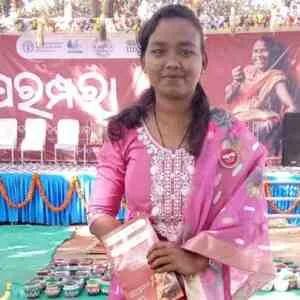
Meena Mallik is a nursing student from Kuradhiphasa village in Paikmal Block, Bargarh District, Odisha. She joined the Village History Team’s documentation work in 2023 and has since contributed consistently to documenting her village’s history, culture, and ecological heritage. The following account describes her experience of village history documentation work and her participation in the Gandhamardan Parampara Mela held at Kharamal village on 8th January 2026. The Village History Team works with young people in communities around the Gandhamardan hills to research and document the histories of their own villages. Meena’s account is published here as part of that effort, as a record. What it demonstrates, above all, is the value of giving young people the means to look closely at the world they have always lived in. The Gandhamardan movement of earlier decades left behind something that figures alone cannot convey: a habit of attention, a conviction that this mountain, this forest, this way of life is worth defending. That inheritance shapes how young people in this region think and what they choose to do. Village history documentation work, when it functions well, does not produce nostalgia. It produces a generation equipped to read the present and to act accordingly. – Swayamprava Parhi

It started with a sheet of paper my younger sister brought home. Taruni, my sister, was in Class Ten at Munikel High School. One day, she walked in carrying a list of questions, handed out by something called the Village History Team, who had come to her school asking students to research and write the history of their own villages. “Didi, help me write about our village,” she said. Just like that, as if it were the most obvious thing in the world. So we sat together, the two of us, and went to the elders. We asked questions we had never thought to ask before, and they answered. We wrote what they said and submitted it. When the Village History Team read what we had sent, they came to our village the very next day. They called a community meeting, and the older villagers gathered and began to speak. And something happened in that room that I didn’t expect. Stories came out, memories folded inside other memories, things I had grown up beside without ever knowing they were there. I sat and listened, and something that had only been a quiet curiosity in me became something larger, something I didn’t have a name for yet. That was the day I started writing the history and food culture of Kuradhiphasa. And I haven’t stopped since.
The Story of our village:
Our village, Kuradhiphasa, sits at the feet of the Gandhamardan hills, surrounded by a beauty that is easy to take for granted when you have grown up inside it. I did not always know why it was called Kuradhiphasa. When I began asking, I found that even the name carries more than one story. I went to the elders. I sat with Kaibalya Mallik, who was ninety years old and has since passed, with Nirmal Patel, fifty-three, and Gopal Das, sixty-two. They told me the name comes down to two competing memories. The first says that long ago, a man killed a snake here using a kuradhi, a local tree-cutting tool, and the place took its name from that act. The second says something quieter: that before anyone settled here, this land was entirely forest, and the people who first came cleared it with their kuradhi, and called the cleared place Kuradhiphasa. I cannot say which is true. Perhaps both are, in the way that origin stories often hold more than one truth at once.
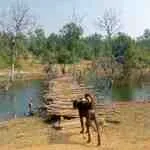
What the elders agreed on was this: a man named Gur Majhi was the village’s first resident. He came from Visakhapatnam. After him came others, Kainia Bhue from Bahabal, then the Kuanra family, then the Mallik family. People of many communities arrived and stayed, and together they made a village. Harihar Majhi told me this. He is seventy-five, and they remembered what their elders told them. The community with the largest presence here has always been the Kandha. And there is a story that belongs to them, to us, that goes back further than the village itself. A Kandha woman named Yamuna Kandhuni, from our ancestral line, was the one who found the deity Nrusinghanath while digging for tubers in the forest. At that time, our people were living in Mandiagrama, a village that once stood near where the Manbhang Dam now sits. Mandiagrama was known for its ragi, grown in abundance, threshed on a great stone. Now that the stone is underwater. The dam came, and with it, the oldest layer of our history slipped beneath the surface. Kuradhiphasa grew out of Mandiagrama, the way a branch sometimes takes root on its own and becomes its own tree.
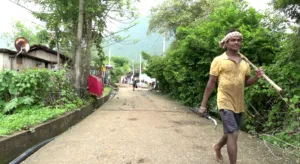
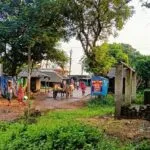
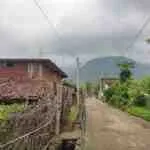
When I asked the elders what the village looked like in its earliest years, Harihar Majhi and Kunjamani Bhue described thatched and tiled roofs. Paths that disappeared in the monsoon. Water was carried from streams because there were no wells or handpumps to speak of. People ate from clay vessels called malakhi. Their food was what the land gave: kandamula, saragi, kodo, mandia. Nutritious things, grown close to home. Malati Mallik, who married into the village, remembers arriving to find forest pressing right up against the edge of the settlement. There were thirty or forty houses then. Three handpumps, five wells, a single school, and no anganwadi centre. The roads turned to mud in the rain.
Now there are eighty-nine households. The population stands at around 347, according to anganwadi worker Ketaki Santa. The roads are paved. The anganwadi centre exists. Seven communities live here together: Kandha, Mali, Teli, Bainjhal, Hatua, Saura, and Gond. People do carpentry work, painting, masonry, and weaving. The forest edge has receded as fields have expanded. The village has changed, the way all villages change, not all of it loss, not all of it gain.
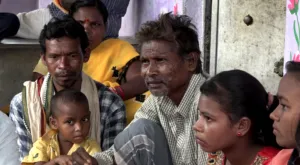
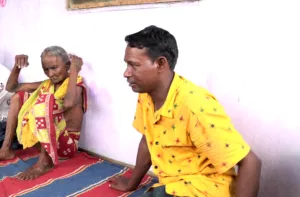
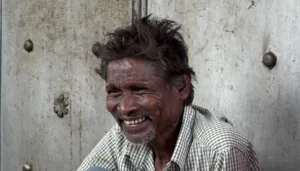
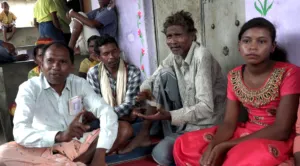
There is something else the elders spoke about, and I want to set it down carefully. Many people from Kuradhiphasa joined the Save Gandhamardana Movement, the struggle against BALCO’s plans for this mountain. I went looking for names, and I found them: Raimati Mallik, Dahana Mallik, Putana Mallik, Gauri Mallik, Kunjamani Bhue, Tutuli Bhue, Phula Santa, Hema Jani, Nepura Mallik, Yuva Jani, Dhanamati Bhue, Mallakena Bhue, Gurubari Mallik, Banamali Kuar, Kaibalya Mallik, Subalay Mallik, Madhusudan Mallik, Sashidhar Bhue, Krupasindhu Bhue, Kameshwar Bhue, Dhaniram Bagh, Gulab Das, Hiralal Jani, Bhagaban Jani, Suku Jani, Nirmala Patel, Nanda Das, Jugeshwar Patel, Surendra Mallik, Dayanidhi Bhue, Garbhadhan Bhue, Sahadeb Majhi, Bidyadhar Mallik, Dulamani Bhue, Narsingha Mallik, Ratnakar Mallik, Daiman Bhuey. There are more. Further research will find them. These were not distant figures. These were the people of our village, the grandmothers and grandfathers of people I know.
The village has eight places of worship: Durgei Gudi, Mati Gudi, Chhuti Gudi, Bhuibahaliena, Karamasani, Domapalien, Thakur Gudi, Mandali, and Bajrangbali. In some of these places, women and girls do not enter, a custom that continues without much being said about it. Beyond the formal shrines, people worship at their own fields, in their own corners of the forest, before the Sikuli and Khanda of their household deities. The mountain and the forest are not separate from the sacred. They are the sacred.
The festivals that mark the year here are Maskira Punei, Chaitra Punei, Nuakhai, Pus Punei, the Paush full moon, Puajeuntia, Bhaijeuntia, and the Chhuti Gudi Yatra. During the Jani Yatra, women dress in sarees and ornaments, men in dhotis and shirts, children in kurtas and salwars. At festivals, the village prepares suanli pitha, arisa pitha, manda pitha, kuna chihira, and food made from mandia. During Nuakhai, gurji, arisa, and suanli pitha are offered to the deity before the household eats. During the Paush full moon, manda pitha. In Margashira, yugara and mandia chakuli. There are three cultural groups in the village, Kirtana, Karamasani, and Ghudka, and during celebrations, there is song, and there is dance, the way there has always been.
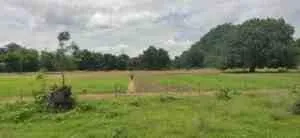
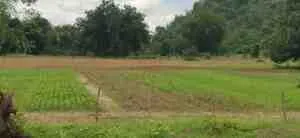
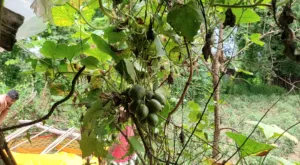
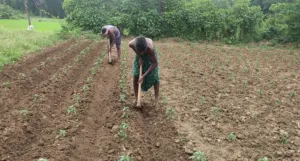
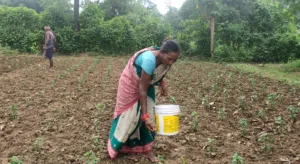
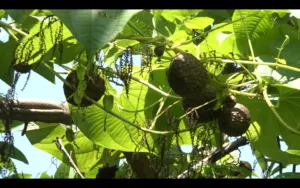
The village holds about 300 acres of land, of which 200 are cultivable. Almost every family depends on farming. Paddy is the main crop, along with mug, biri, mandia, kulatha, and vegetables. Some grow cotton. But there is no irrigation. Farmers depend on rain. After sowing, they wait ten to fifteen days to irrigate, and when the paddy ripens, it is threshed by machine and stored in sacks. The forest supplements what the fields cannot provide: chara, mahua, honey, jhuna resin, rengal leaves, and medicinal roots. More than eighty people from this village have left for work in other states, sending money home for seeds and fertiliser. The longer they stay away, the more the traditional farming knowledge fades. This is a loss that doesn’t announce itself. It just quietly disappears. Kunjamani Bhuey, who is ninety-five years old, told me that food has changed more than anything. The older generation ate mahua, chara, kendu, mandia, gurji, kodo, saragi mudi, tikira, kangu, janha, gangai, mug, biri, things that came from the forest and the fields. Now people eat rice, dal, vegetables, roti, puri, and sweets. Foods like Gurji, Raksi, Kangu, Suan, Duker Pitha, Sikara, Kulia Kandha, and Khusa have been largely forgotten. Two children in the village, Gandharba Mallik, thirteen, and Hemant Mallik, eleven, told me their favourite foods are Chakuli Pitha made from rice, Suji Halua, Manda Pitha, and Maggi. That last one made me think. Nutritious grains like Bajra, Kodo, Gundali, Gangai, Janha, and Kandamula have largely disappeared from daily meals. A few families still eat Kodo and Ragi.
The mothers of our village are the ones who carry the knowledge of how traditional foods are made. The knowledge has not gone yet. But it is going. What follows are some of the sweet dish recipes they told me. Almost every household in Kuradhiphasa prepares arisa pitha and suanli pitha for Nuakhai. These are not recipes written down anywhere. They live in the hands of the women who make them.
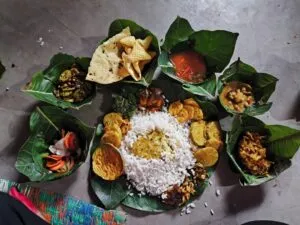
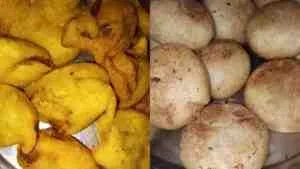
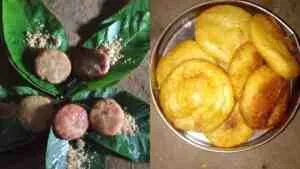
Arisa Pitha: To make arisa pitha, rice is first soaked in water for an hour or two, then drained and placed in a tupuli, a woven basket, and taken to the dhenki, the foot-operated wooden mortar, where it is pounded into flour. The flour is sifted through a strainer and set aside in a clean basket. Then a fire is lit, and in a clean vessel, a little water is heated with sugar or jaggery until it boils well. The pounded rice flour is added to this and stirred thoroughly so that everything comes together evenly. This mixture is left to cool. Once it has cooled, the oil is heated in a pan, and the dough is shaped by hand into flat rounds and lowered carefully into the oil to fry. That is Arisa Pitha.
Suanli Pitha: Suanli pitha follows a similar path, but with its own distinct steps. The rice is soaked for two to three hours this time, then drained, placed in a bhuga or tupuli, and pounded at the dhenki. The flour is sifted as before. Then water is set to boil on the fire, and into it go sugar and a little salt, just enough to bring out the flavour. The flour is added to this salted, sweetened water and stirred until everything is well combined. The mixture is taken off the heat and left to cool. Then, as with arisa pitha, the dough is shaped flat by hand and fried in oil. That is suanli pitha.
Kuna Chihira: Kuna Chihira is the food that belongs most completely to Nuakhai, because it is made from the new paddy, the first harvest. Fresh paddy is brought in, husked, and set aside, then roasted. After roasting, it is left to cool a little and then ground on the grinding stone or pounded in the mortar. Simple, and entirely of this season.
What I noticed, talking to the mothers and daughters of this village, is that this knowledge is unevenly held. Some women know exactly how to make Suanli Pitha, Arisa Pitha, and Chakuli. Others have never learned. And the older preparations, Dukei Pitha, for instance, which the previous generation made, are now known to almost no one. The knowledge is still here, but it is held by fewer and fewer hands, and the hands that hold it are growing older. This, too, is something worth recording. Before it is gone entirely.
The village’s health sits uneasily. The Village Welfare Committee, the ASHA worker, and the anganwadi staff work to keep the settlement clean and disease-free, and for the most part, they succeed. Vaccinations happen every fourth Wednesday of the month. Mothers take their children to the hospital for delivery. Diseases like cholera, diarrhoea, and measles that once swept through the village have not been seen in years. But malaria, typhoid, and cold fever remain common. Some people, when they fall ill, go to the doctor; others still go to the Shaman and the Exorcist. Anaemia is a great problem. Night blindness appears. Malnutrition affects some children, including low weight, vomiting, and stunted limbs. There is no primary health centre in this panchayat. There is a sub-centre five kilometres away, and a health centre ten kilometres further. For serious illness, families travel a hundred kilometres to Burla Medical, through the night, by whatever transport they can find. Some do not arrive in time. This is one of the village’s quiet, ongoing sorrows.
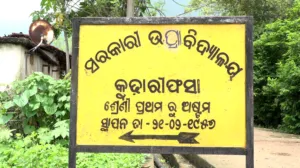
There is also the question of education. The village has one upper primary school and one anganwadi centre. About eighty children study at the school. Approximately thirty-five do not study at all; they work on farms, or they drift to factories when farm work runs out. There is no higher secondary school nearby. Young people who want to study beyond a certain point must leave. Many leave and do not come back. The elders speak of this with a grief that has been sitting in them for a long time.
I came to this work through my younger sister’s homework. I stayed because of what I found: a village full of history, and I had been living inside without knowing it. The name of the place I grew up in. The woman, Yamuna Kandhuni, is our ancestor. The people who stood on this mountain refused to let it be taken. The foods that sustained us for generations are now slipping away. The illnesses that have been defeated, and the ones that remain.
Writing the history of Kuradhiphasa gave me something I had not expected. Not just knowledge, but the feeling that the world I had always lived in was deeper than I had known, and that it was worth understanding, and worth recording, before more of it is gone.
The Day at Kharamal Parampara Mela:
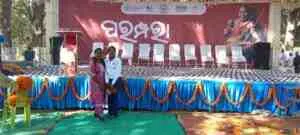
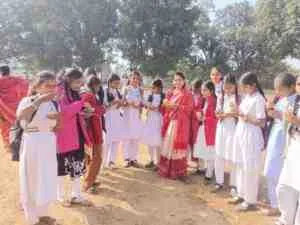
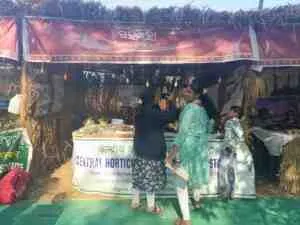
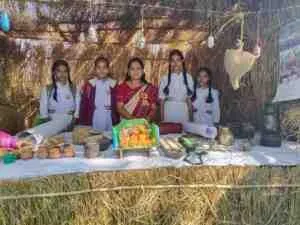
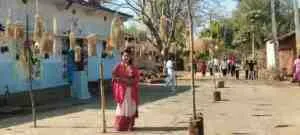
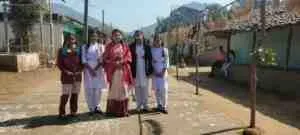
On the 8th of January, 2026, my sister and I travelled with the Paikmal Village History Team to Kharamala village for the Gandhamardan Parampara Mela.
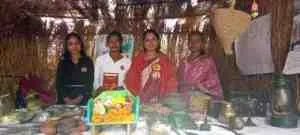
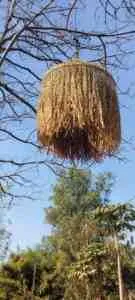
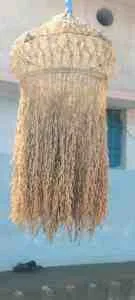
The name said everything, really. “Parampara”, tradition, lineage, the thread passed hand to hand. And the fair looked exactly as its name promised. The entrance was decorated with handmade bamboo ‘kulai’ and ‘changara’, baskets woven from the dry leaves of the tala palm, arranged with a care that no machine could replicate. The stalls inside were built to resemble the old thatched mud homes of our grandparents’ time, and Samadhwani, Ahimsa Club, an Ayurvedic college, and women from various self-help groups had all set up within them. On either side of the stage stood old bullock cart wheels and ploughs, freshly painted, given new dignity. Braided garlands of paddy stalks hung across the front. At the centre, a ‘olia’, a granary woven from straw, had been placed, and around it designs drawn in ragi millet, and in the middle of it all, a single flower, as if the whole stage were an offering laid at someone’s feet.
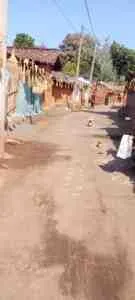
After breakfast, my sister and I walked into the village. What we found there, I will carry for the rest of my life. Every doorstep had ‘jhoti’ painted on it, white patterns drawn on the earth, like a white silk saree draped over the body of the mother earth herself. Braided paddy garlands hung along the lanes on either side, like ornaments. At every doorway, a pot decorated with paddy stalks stood waiting, as if Goddess Lakshmi were expected at any moment and the family wanted to be ready.
And in one corner of the village, a seed market. Seeds stored and displayed in a beautifully woven straw ‘olia’, each variety in its place, patient and alive.
Then a stir moved through the gathering. Haladhar Nag had arrived. Our people’s poet. He was welcomed with Dalkhai songs, music and dance, the kind of welcome you give someone whose words have lived in your mouth for years. And shortly after, our MLA, Smt. Barsha Singh Bariha joined too. She walked through every stall, sat with the gathering, and when she was asked to speak, she promised to take steps toward preserving these traditional seeds and grains. Whether that promise holds is another question. But in that moment, among all those people, it mattered that it was made.
The people who had spent years collecting and preserving these old seeds, quietly, without announcement, in their homes and farms, were honoured on the stage. I sat there watching them receive that recognition and found I had to look away for a moment. The good kind of tears, but still.
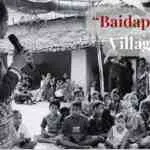
Students had come from schools across the region. A student from Chhindekhela High School gave a speech about protecting Gandhamardan that left the audience first very still, then very loud. Students from Yamuna Kandhuni Girls High School and others received prizes. We sat for lunch in traditional leaf bowls made of sal, rice from desi paddy, dal, khata, and khiri. Then the cultural programs. Girls from Yamuna Kandhuni School danced to “Chhota mora gaan ti”, “my little village”- the Village History Song. Himani Pradhan, a student historian from the same school, spoke about her experience of writing the history of Baidapali, her village. And then the girls from Temri High School performed a village history ‘pala’, a traditional folk theatrical form, telling the story of their own village, Temri, through it. I watched them on that stage and thought: this is what it looks like when young people inherit something and decide to carry it forward.
Thousands of people came to the Village History stall that Samadhwani had organised. They listened. They spoke to us. They asked about the old objects on display and what they meant. Some of them recognised things they hadn’t thought about in years. Some recognised things they had never known had a name.
What stayed with me most, driving back, was something someone mentioned about Kharamala: the people of that village have never used chemical fertilisers. They farm with desi cow dung manure, the way it has always been done. In a world quietly poisoning its own soil, where people have stopped growing ragi, gurji, kodo, raksi and maize and forgotten what the body needs, this village has held its ground. I think about that as a nursing student. I think about those hundred-kilometre journeys to Burla. I think about what good health actually costs, and what it actually requires. And I think it comes from the earth, tended the right way, by people who still remember how.
If you are a student reading this, write the history of your village. Sit with the elders. Ask them what they remember. Record the names, the stories, the seeds, the songs, especially the things that don’t seem important yet, because those are usually the things that matter most. You will be surprised at how much joy is buried in that work, and how much of yourself you find in the process. I know, because I found myself there too.
(The original story was published in Samadhwani Odia Print Magazine. This is a translated version)