
Editorial Note: Villages are the foundation of culture, the wellspring of identity. Every village carries its own history, its struggles, and its dreams. In this special feature, we present a remarkably insightful documentation by Riya Anjum, a high school student from Shree Gopaljew High School in Niali, Bilashuni, Odisha. Riya has meticulously researched and chronicled the story of her ancestral village, Adhanaga Basti, located in Alana Gram Panchayat of Cuttack District. With remarkable maturity and sensitivity, she weaves together three temporal threads, the past, the present, and her vision for the future, into a compelling narrative that transcends local boundaries to address universal themes of communal harmony, development, and cultural preservation. This article emerged from Riya’s participation in a competition announced by “Samadhwani” on April 1st, 2025, on Odia Language Day, which encouraged young people to document and reflect upon their villages. What makes Riya’s work particularly significant is not merely the historical data she has gathered, including vivid accounts of the devastating 1999 super cyclone, the evolution of Hindu-Muslim relations, and the village’s infrastructural transformation, but her honest assessment of what has been gained and lost in the process of modernization. Her writing reveals a young mind grappling with complex realities: the paradox of improved literacy alongside declining human relationships, the arrival of paved roads concurrent with the disappearance of traditional crops like Ragi, a super food, and the spread of concrete housing, accompanied by the erosion of communal bonds. Most poignantly, she acknowledges these contradictions without cynicism, maintaining hope that progress need not require the sacrifice of what makes communities truly flourish. At an age when many students view their villages as places to escape from, Riya demonstrates the opposite impulse, a desire to understand, preserve, and improve. Her dream of a village with both modern amenities and restored harmony reflects a thoughtful understanding that development should enhance rather than replace traditional values.
“Samadhwani” welcomes this beautiful effort and the sincere desire evident in someone so young to establish harmony and goodwill. We are confident that Riya will continue this important work, conducting deeper research and producing more comprehensive documentation of her village in the future. Her voice represents a generation that refuses to accept false choices between tradition and modernity, between identity and progress. In publishing Riya’s work, we hope to inspire other young people, first in her own school and neighboring institutions, and eventually across the globe, to become documentarians of their own communities, to seek out elders and learn from their memories, to observe the present with discerning eyes, and to imagine futures where heritage and progress walk hand in hand. The story of Adhanaga Basti is ultimately the story of countless villages worldwide navigating the turbulent waters between preservation and transformation. That this story has been told by a high school student with such clarity and compassion gives us hope for the future of both journalism and community building. – Swayamprava Parhi
My Dream Village: Adhanga
By Riya Anjum, Student, Shree Gopaljew High School,
Bilashuni, Niali, Cuttack
In the heart of Odisha’s Cuttack district lies Adhanaga Basti, a village of approximately 1,000 households where over 2,000 people-both Hindu and Muslim- have built their lives together. I am Riya Anjum, a high school student from nearby Niali, and this is the story of my ancestral village, a place that has taught me that progress and loss often walk hand in hand.

A Past Woven with Threads of Unity
My elders speak of a time when Adhanaga Basti was simpler but perhaps richer in spirit. Dirt roads connected modest homes, electricity was unreliable, and most villagers couldn’t read or write. Yet what the village lacked in infrastructure, it made up for in something far more precious: genuine communal harmony.
Hindus and Muslims didn’t just coexist—they lived as brothers. During Id-ul-Fitr and Id-ul-Zuha, fairgrounds would spring up, attracting people from surrounding areas. Similarly, during Ganesh Puja, Saraswati Puja, Holi, Diwali, and Dussehra, the entire village would celebrate together. When disputes arose in Hindu households, two respected Muslim elders—Mansur and Alli Maghasa—would mediate. At Hindu cremations, Muslim neighbors would assist with the final rites, just as Hindus would help Muslims with burials.
The village economy revolved around agriculture. Farmers grew rice, sugarcane, millet (mandia), lentils (biri), and horse gram (kolatha). Women prepared traditional foods—pitha (rice cakes), lachha (sweet vermicelli), and khiri (rice pudding)—during festivals. A canal provided irrigation during dry seasons, and betel leaf (pan) cultivation thrived.
The Super Cyclone That Changed Everything
October 29, 1999, remains etched in village memory. The super cyclone that devastated coastal Odisha struck Adhanaga Basti on a Thursday and Friday, with rain and wind battering the village for two full days. Most Muslim families lived in mud houses, which collapsed in the storm. My family had an asbestos-roofed house, and during those terrifying days, 40-50 neighbors sheltered with us. Others took refuge in the village school. Lives were lost. Livestock perished. Trees were uprooted. The destruction was total. Relief came a week later, but electricity remained cut for a month. The cyclone didn’t just destroy homes—it marked a turning point in the village’s trajectory.
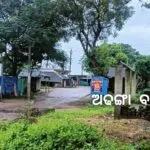
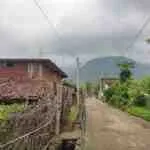
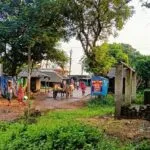
Today’s Adhanaga Basti looks dramatically different. In 2002, paved roads replaced dirt paths. Nearly all houses are now concrete structures. In 2024, a government scheme brought water taps to every home, with supply twice daily. The village now has an Urdu school, an Odia school, and an Anganwadi center. The nearest hospital is 8 kilometers away in Niali. Many villagers have died during emergency transport. Though a hospital is finally under construction after sustained advocacy with political leaders, the delay has cost lives. A Canal has been constructed, enabling fish and poultry farming alongside traditional agriculture. Government tube wells dot the landscape. Modern machinery has replaced manual labor in farming. Children no longer work in fields; they attend school. Literacy rates have climbed. Some villagers have achieved remarkable success; one resident, Golamudeen Sa, worked for the Income Tax Department. Yet progress has exacted a toll. The forests that once provided timber, fruit, flowers, and medicinal herbs have been cleared for housing as the population has grown. Plastic waste now litters areas once pristine. Traditional crops like millet have disappeared from fields and dinner plates; nobody wants to eat mandia porridge or biri, Kolatha dal anymore. Most painfully, the social fabric has frayed. The interfaith harmony that once defined Adhanaga Basti has weakened. Small disagreements now escalate into conflicts. Festivals that were once communal celebrations are now observed separately. The mosque and temple still stand, but the space between them feels wider than ever.
A Dream for my Village
As I walk through Adhanaga Basti during school holidays, watching children play cricket and attending the occasional magic fair that brings five days of entertainment, I carry a dream. It’s not an impossible fantasy, but a practical vision rooted in memory and possibility. I dream of a village where the hospital is operational, where the few remaining thatched-roof dwellings are replaced with sturdy homes, where clean streets are lined with trees, and where a park provides recreational space. Most importantly, I dream of restoring what once made Adhanaga Basti special: a community where people share both sorrows and joys, where festivals unite rather than divide, where disputes are resolved through dialogue, and where discrimination has no place.
This is not nostalgia for a past that never existed. My village’s history includes floods, illiteracy, and poverty. But it also includes something increasingly rare: proof that people of different faiths can genuinely live as a family. As a young student documenting my village’s story, I believe we don’t have to choose between development and community, between progress and compassion. My generation’s challenge is to reclaim the best of Adhanaga Basti’s past while embracing the opportunities of its future. The canal still flows. The mosque and temple still stand. The memory of neighbors sheltering together during the cyclone remains alive. These are the foundations upon which my dream village can be built, not in some distant future, but starting today, with awareness, effort, and renewed commitment to the values that once made a small village in Odisha a model of what communities everywhere should aspire to become.
The original story is published in the Odia language. Here is the link: https://samadhwani.com/9545