
It was 1943-44… I was about 10 years old then.
Our village, Nariso, was surrounded by forests on all sides. Even in broad daylight, it felt dark under those thick trees. The village was scattered in small hamlets deep in the jungle: Brahmin settlements, Pradhan hamlet, Teli hamlet, Hatua hamlet. The upper caste families built their houses in the open clearings.
Then there were the untouchable castes – Bauri, Dhoba, Kandara, Dom. We called them that. They couldn’t live with us. The Saantas – the land-owning upper caste people – had proper land, farms, and gardens. But the Dalits? They had to squat wherever they could find space. On pond banks, hillocks, and fallow patches. They made small huts on the Saanta’s land. There were no proper roads to reach their homes. Just narrow, winding paths like snakes threading through the jungle. The Brahmins held all the power. They controlled the thirty-six Patakas of our area. Brahmins, Karans, Chasas, Khandayats – farming was their main work. These were the upper castes, the respected people. The Zamindars, makaddams, and farmers owned all the land. The Dalits? They didn’t even have a handful of earth to call their own. They worked as servants in the makaddam’s houses. Living as bonded laborers, year after year. Their daily wage was four sers of paddy. From sunrise to sunset, the yoke stayed on their shoulders. Ten hours of backbreaking work, every single day.
They squatted on whatever fallow land the Saantas allowed them. From each Dalit family, one person was bound to serve the Saanta all year round. Boys as young as seven or eight years old would start working, continuing until they were fifteen or sixteen. The mothers worked in the Saanta households too – cleaning grain, spreading manure, weeding, harvesting paddy, winnowing, and doing all the harvest work. When they found time, they would gather wild greens from the fields and gardens. They collected dry branches and leaves for fuel. They caught crabs, prawns, and fish from wherever they could. The girls? Bauri household girls would either go sweeping from door to door or do earthwork in the fields. They went from house to house, twelve houses in all, filling their baskets with sweepings, branches, and leaves to take home. The stove had to be lit every day. When they grew up, they would go with their parents to work in the muddy fields. Their wage was just two kilos/Sera’s pady.

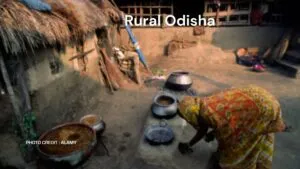
This was the simple truth – if you wanted to eat, you had to work. In Dalit homes, whatever came from hard labor went straight into the cooking pot. When husband and wife both worked for three or four days, they would earn three or four bags of paddy. At night, they soaked the paddy. During the day, they dried it in the sun. In the Dalit hamlet, there was one and a half dhenki – the foot-operated husking tool. Children and adults together would husk the paddy to make rice. That rice had to last three or four days. For vegetables, the mothers would go out at dawn, roaming the fields and gardens, gathering whatever wild greens they could find. Madaranga, kanisiri, thorny leutia, khada, leutia, panchbani greens – whatever grew wild. The fathers would set traps by ponds, canals, and river banks. They would bring back half a ser to a ser of knotty shrimp, muhuradi, crabs, and black crabs every day. Their meal was simple – pakhala bhata (fermented rice water), fried wild greens, roasted fish, and crabs. Sometimes they made crab chutney. They would pile up trash and light a fire, roasting the crabs right there. Once roasted, they removed the shells. A few drops of mustard oil. A few chilies. They crushed garlic cloves, added salt, and pounded everything together. The rice would be ready in the bronze vessel. For fish, they cleaned it, wrapped it with turmeric, salt, chilies, and a few drops of oil in pumpkin leaves, and tossed the packet into the stove. When the rice was ready, they would take out the packet and extract the roasted fish. Everyone’s mouth would water at the smell. Greens, crab chutney, fish chutney – whatever was available that day. They ate their pakhala with these simple things, drank the rice water, and went back to work.
I remember the Ashinya-Kartika(October- November) months. The field work would be finished by then. There would be eggplant beds in the gardens, small tasks like turning bent paddy stalks upright. This was the men’s work. What would the women do? They would go out in groups to catch fish from ditches and ponds. Without the men lifting a finger, they wanted to eat good food when they returned. Coming back from work, the men would sit down and ask, “There’s a whole pot of rice, but what will we eat with it?” Poor women! Whether in touchable or untouchable households, they were the ones burning in the fire of work. All the troubles fell on them. They would take torn fishing nets and tools and go out for three hours of hard work. They never came back empty-handed. Small fish, big fish, crabs, prawns, kochia – something or other was always caught. With half a kilo to one kilo in their hands, they would return home.
The daughter-in-law or mother-in-law would have cooked the rice already. They cleaned the fish and crabs. Time to cook the curry. They cut the kochia into pieces, added a few drops of cooking oil, and gave it a few turns with turmeric water. Kochia fish is very slippery – when fried, oil comes out. It needs to cook longer. If there were a brisingha tree at the door, they would add ten or twelve leaves to the curry. If someone’s catch included half a kilo of thorny shrimp, that was like heaven’s blessing. The same few drops of oil. They fried the shrimp until red, added turmeric, and raw chilies – that shrimp curry was something special. The men would sit down eagerly to eat. But not every home had such food every day. At Bauri Babar’s house, what could be found in comfort daily? Whichever day something was available, it was a feast like a tiger’s meal. When there was nothing, they drank the wind and slept hungry.
I remember there was a saying in the village about them: “Pausha month – plenty to eat, cooking three times. When Pausha ends – cry in poverty.” In the Pausha month, after the harvest, the Dalit homes would be full of paddy. For three or four months, food and drink would go well. Traders would come to the hamlet early in the morning. The Dalits would exchange their inferior, broken paddy for three to five rupees. Money was valuable then. Goods were cheap. The women would take that money and go to the fair. They would eat bara and vegetables, buy mirrors, alata, sindoor, pots, and earthenware, and return home with bundles. By the Falguna month for the Dola festival, the pots and pans would be empty again. I remember the Chaitra month, the Patua fair – a big festival for the Bauris. One day, Budhia went to the Saanta’s house. He stood there bowing and scraping. “Hey Budhia, what’s the matter?” the Saanta asked. “Why are you standing there like a post?”
“No, Saanta,” Budhia replied. “Chaitra festival is here. There’s nothing at home. If you give me ten or fifteen bags of paddy, I’ll work it off in wages.”
“Hey, didn’t you get a whole basket full of paddy? It finished so quickly?”
“Saanta, I have children and a household. Your maid – you saw – she swallowed it all like a snake. With buying and selling, everything is finished. She sent me to bring paddy from your house.”
“Fine, you’ll get paddy – I’ll give twenty bags. You’ll work off thirty bags in wages.”
Budhia burst with joy inside. He loaded the paddy sack on his head and returned home.
For the Patua fair, they needed chakuli for the Meri puja. They made four or five bags of paddy into aromatic rice. The mustard harvest was done – they had gotten five to seven bags. There was a coconut tree in front of the hut. They plucked the coconuts half-ripe. For chakuli pitha, they needed three or four half coconuts. They ground mustard, rice, and coconut on the grinding stone, making ten to fifteen chakulis.
For poda pitha, they took a bag of paddy to the shop and brought back jaggery and spices. The shopkeeper gave them black pepper and cloves wrapped in a small paper packet. Mother and daughter ground the aromatic rice in the mill. They had bought a big deep earthen pot from the potter’s wife for four sers of paddy. They layered thick banana leaves in the pot, poured in the rice mixture with jaggery, coconut, and chopped spices. They placed it on the stove with fire below and fire above – the pitha cooking in between like an old man sitting.
It was past midnight. The daughter had cooked rice and dal. Fish curry was ready. The feast was laid. Father and daughter dozed off, but someone had to watch by the stove. If it burned too much, the pitha would char. If taken off too soon, it would be raw. They had learned from the Saanta’s wife how to make pitha. Pitha-pana was a very intricate work, mentally taxing. Odia household daughters and daughters-in-law were experts in it. So what if she was a Bauri household woman? In Odisha, we learned by watching. Going to the Saanta’s house regularly, they learned to make half a dozen types of pitha. But their mind stayed worried, their work was always half-done. Nobody had peace of mind. No wealth either. Still, turning their backs on every storm, they steered their boats through life. The pitha was finally baked and ready. It smelled fragrant. Morning would bring cleaning and sweeping. Afternoon would be Khunta Puja after offering chakuli and poda pitha, finally eating and drinking.
This is what I remember of the Dalit kitchen from those days.
Editorial Note:
We publish this deeply moving account with immense respect to Natabar Sarangi. Natabar Sarangi, the author of this remarkable piece, has left us, but his words are so powerful and humane that they continue to speak. Born into the soil of coastal Odisha, Natabar Sarangi was not merely an observer of rural life; he lived it. As a child in 1943-44, he witnessed firsthand the harsh realities of caste-based discrimination, the daily struggles of Dalit communities, and the unspoken hierarchies that governed village existence. What makes his writing extraordinary is not just what he saw, but how deeply he felt it, and how honestly he chose to tell it. In “Remembering the Dalit Kitchen in the 1950s,” Sarangi does something rare and precious – he takes us inside spaces that were deliberately hidden, voices that were systematically silenced, and lives that were considered unworthy of documentation. Through vivid, sensory details – the smell of roasted fish wrapped in pumpkin leaves, the taste of crab chutney made with a few drops of precious mustard oil, the exhaustion of ten-hour workdays for four Kilos of paddy – he brings to life a world that history books often ignore.
This is not romanticized nostalgia. Natabar Sarangi’s story is clear-eyed about the brutal inequalities of his childhood village – Dalits living on pond banks because they owned no land, children as young as seven bonded to upper-caste households, women working dawn till evening and still managing to create moments of culinary ingenuity from wild greens and caught fish. The Dalit women who learned to make elaborate pithas by observing in upper-caste kitchens where they worked as servants possessed the same intelligence, the same artistry, the same cultural sophistication – only without the recognition, the resources, or the respect. This is oral history at its finest – preserving not just facts but the texture of lived experience. Documenting these stories was an act of justice. In a society that tried to render Dalit lives invisible, he made them visible. In a culture that dismissed Dalit food as inferior, he showed its complexity and meaning. In a world that denied Dalit humanity, he affirmed it on every page.
His passing is a profound loss. But in these stories, Natabar Sarangi remains powerfully alive. He has left us an inheritance: the responsibility to continue telling these stories, to continue challenging injustice, and to continue learning from those whom society tried to silence. His words live. And in preserving these stories, we keep alive not just his memory, but the memories of all those who labored, loved, cooked, celebrated, and survived in the face of systematic oppression. This is his legacy. This is his gift to us. Natabar Sarangi wrote originally in Odia. We have translated his work for a wider audience. The original Odia text can be found below.
– Swayamprava Parhi
Link to the Odia Article: https://samadhwani.com/9849